
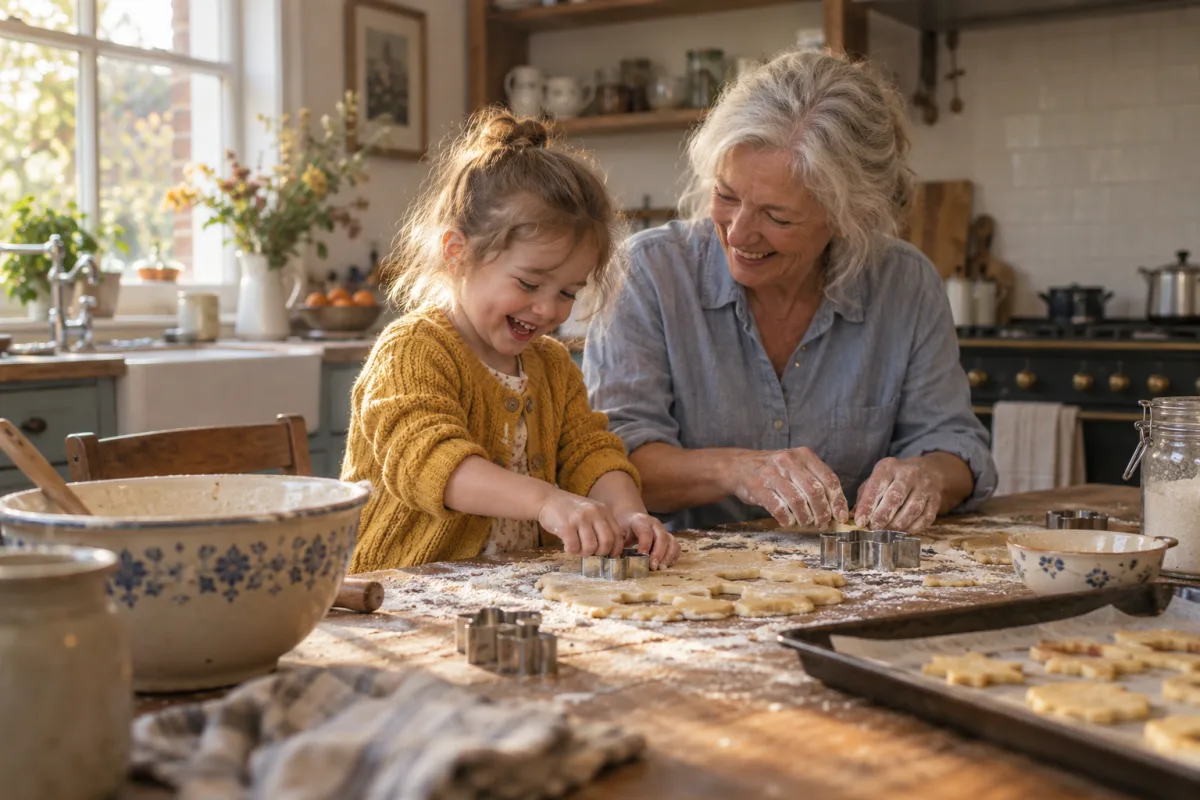
Imagine finding a photograph of yourself as a small child, standing on a chair in someone’s kitchen. There’s flour on the table, something half-made in front of you, and an adult beside you who looks very pleased to be there.
You can see the room. You can see your younger face. But you can’t hear the conversation.
Were you making something for a birthday? Did you insist on doing the difficult bit yourself? Was there a joke everyone told for years afterwards?
Just outside the frame
A photograph gives a memory somewhere to begin. The words around it can give it depth.
Not a long account. Sometimes a sentence is enough:
You decided every biscuit needed a name before we could eat it. We spent longer naming them than making them.
That’s an invented example, but the shape of it is familiar. A small detail changes what you see. The kitchen becomes a particular afternoon, and the child becomes a particular person.
Someone else was there too
The person who took the photo might remember one thing. The person in it might remember something else. A grandparent may have noticed a question, a new confidence, or a habit that the parent never saw.
Those perspectives are part of a child’s story. Collecting them gives the archive more than one voice.
It can also preserve the way someone tells a story. Their favourite expressions. The detail they always return to. What they found funny about you.
You don’t need a special occasion
It’s easy to write something down on a birthday or a first day of school. Ordinary days don’t announce themselves in the same way.
But a familiar walk, a kitchen chair, or a bedtime routine can mean a great deal when the years have passed. They hold the texture of a life, rather than only its milestones.
The next time you save a photo, try adding what the image doesn’t explain. Who was there? What did someone say? Why did you want to remember it?
And if there’s no photo, write the words anyway.
A small beginning
For You, Later is a place to gather those stories for your children, with contributions from the people who love them.
You don’t have to reconstruct a whole childhood today. Start with one moment. If the blank page feels daunting, our memory prompts can help you find a first sentence.